

What does practical completion mean?
The works are complete and can be used for their intended purpose, even though minor defects may remain. It is the point where the client takes the works over.
Fill it in on site, sign on screen, and send a professional Completion PDF before you leave the job.
Free to build · Send it with a 7-day free trial
Need a Completion for your own property? It's issued by the tradesperson who does the work — TradePlanr is the app they use.
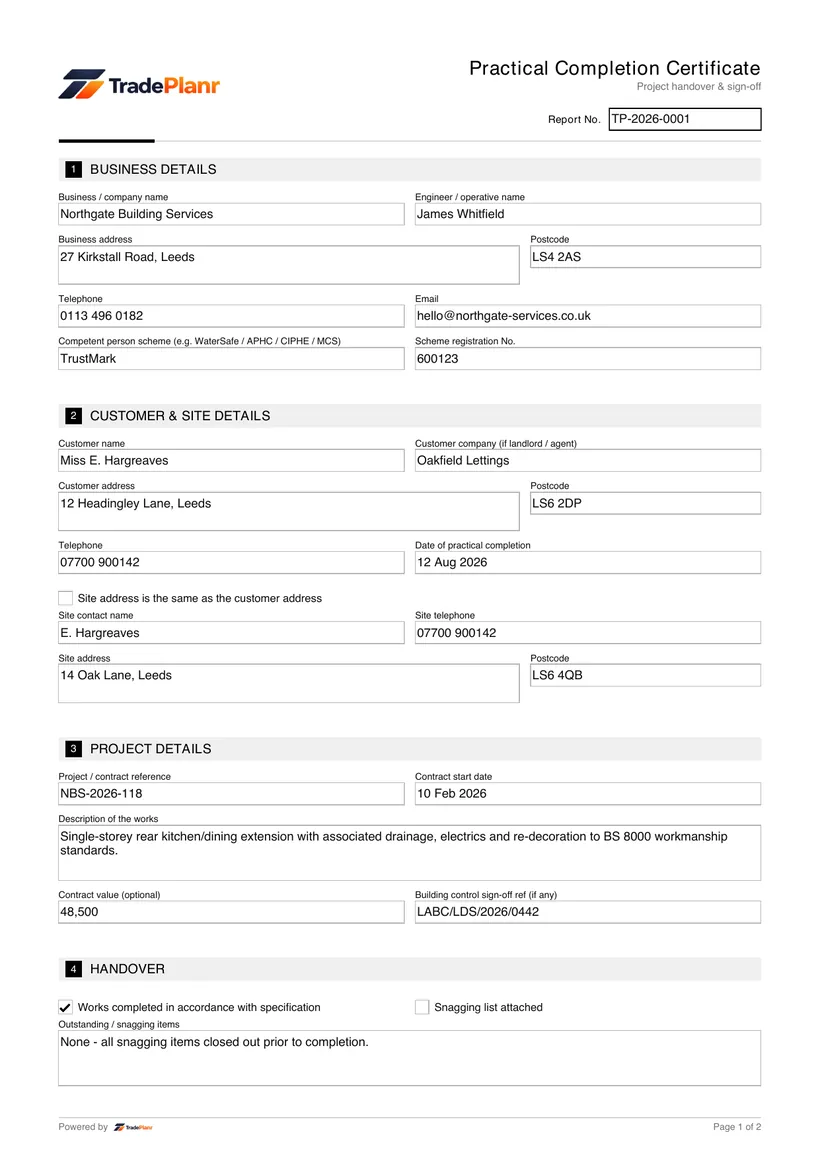
A practical completion certificate confirms that building or installation works are complete and ready for use, apart from any minor defects that can be put right without preventing the client from taking the space over.
Practical completion is a key milestone in JCT and RIBA contract practice: it typically triggers handover, starts the defects liability period and releases part of any retention. For smaller trade jobs it is simply the clean record that the job is finished and accepted.
TradePlanr lets you describe the works, list any snagging items and record the handover on site, then produce a signed PDF certificate for the client and your records.
A practical completion certificate is issued when the works are finished enough for the client to occupy and use them, with only minor items outstanding. On formal contracts it is issued by the contract administrator; on trade jobs the contractor issues it at handover.
The certificate matters because of what it triggers: handover of the works, the start of any defects liability period, insurance responsibility passing to the client and, where retention is held, release of the first part.
A written record with a snagging list protects both sides, fixing what was outstanding at handover so later disputes about the state of the works have a reference point.
Record the client, the site and a clear description of the works being certified, along with the contract or quote they were carried out under.
Add any snagging or minor defect items still to be completed, so the certificate records exactly what was outstanding at handover.
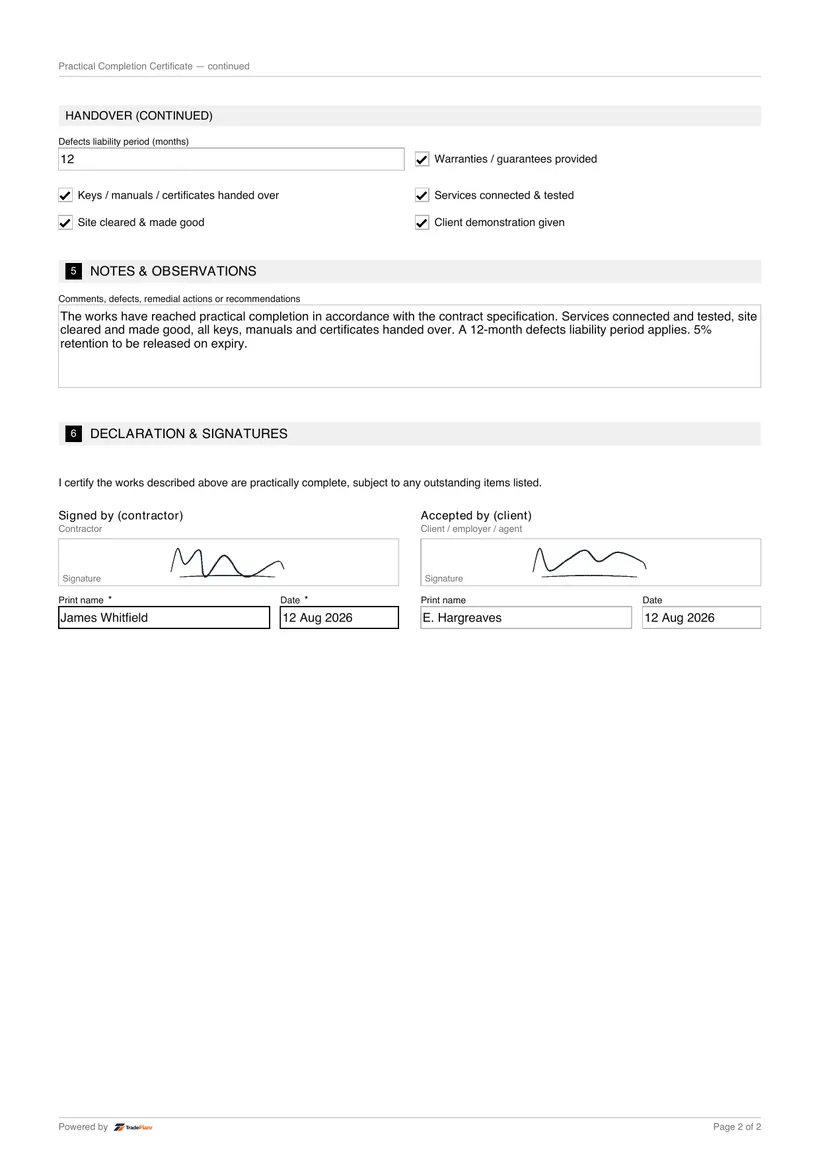
Note the completion date, what was handed over, and any defects liability period agreed with the client.
Capture signatures from both sides, generate the PDF certificate and store it against the job with the related compliance certificates.
TradePlanr generates this and 79 other gas, electrical, oil, plumbing and renewables certificates as proper PDFs — filled on site, signed on screen and stored against the job. Works even with no signal. Free to start.
The works are complete and can be used for their intended purpose, even though minor defects may remain. It is the point where the client takes the works over.
Typically handover, the start of the defects liability period, insurance responsibility passing to the client and, on contracts with retention, release of the first half.
Yes. Listing the outstanding minor items on the certificate fixes what both sides agreed was left to do, which avoids disputes during the rectification period.
Yes. TradePlanr lets you describe the works, list the snags, capture both signatures and produce the PDF at handover.
A written guarantee of labour and workmanship to hand over when the job is done.
The BS 7671 model EIC for new circuits and installations, filled and signed on site.
The Benchmark commissioning checklist completed when a boiler or heating system is installed.
TradePlanr Agency builds custom-coded, SEO-optimised websites and runs Google Ads for UK trades — from £375, by the team behind TradePlanr.
Explore TradePlanr Agency