

Who can issue a BS 5839 fire alarm certificate?
A competent person responsible for the relevant stage of work issues the certificate, for example the designer, installer or commissioning engineer, confirming their part meets BS 5839.
Fill it in on site, sign on screen, and send a professional Fire Alarm PDF before you leave the job.
Free to build · Send it with a 7-day free trial
Need a Fire Alarm for your own property? It's issued by the tradesperson who does the work — TradePlanr is the app they use.
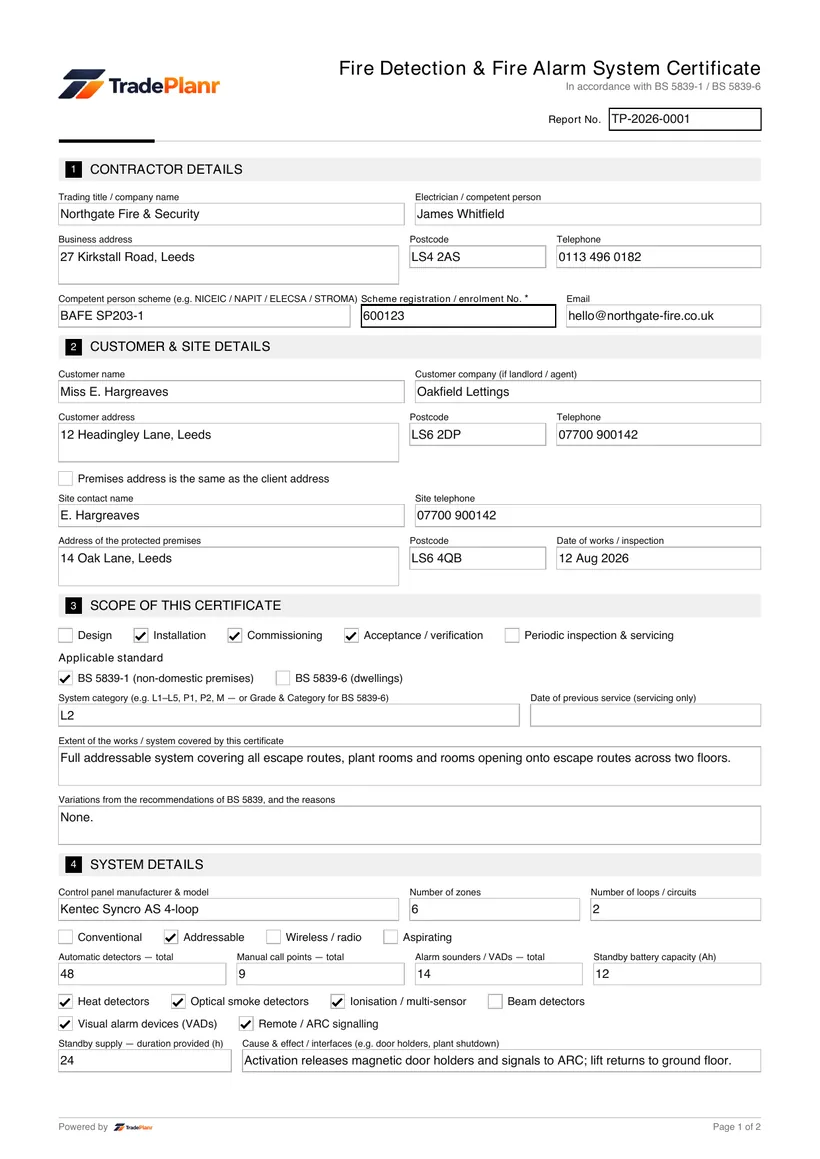
Issue BS 5839 fire alarm certificates — design, installation, commissioning or acceptance — from your phone or tablet on site, with the system category recorded and a branded PDF in the responsible person's inbox before you leave.
BS 5839 covers fire detection and fire alarm systems, and the associated certificates document the different stages of a system's life. These typically include design, installation, commissioning and acceptance certificates, each confirming the responsible party has carried out their part of the work to the standard.
BS 5839-1 applies to non-domestic premises such as commercial and industrial buildings, while BS 5839-6 covers fire detection and alarm systems in domestic premises. The certificates also record the system category, for example L1 to L5 or M, which defines the level of protection provided.
TradePlanr lets you complete the relevant BS 5839 certificate on your phone or tablet at the property, record the system category and produce a clean PDF for the responsible person and your own records.
Fire detection and alarm certificates are produced as a system is designed, installed, commissioned and accepted. Each certificate confirms that a specific stage has been completed to BS 5839, and together they provide a record for the responsible person.
For non-domestic premises the responsible person under fire safety legislation needs evidence that the fire alarm system is fit for purpose, and BS 5839-1 certification supports that. In domestic premises, BS 5839-6 certification is often required for building control, landlords or property sales.
Recording the system category is important because it defines the intended level of protection. Keeping the certificates on file makes it easier to demonstrate compliance during inspections, insurance reviews and future servicing.
Record the property address, responsible person, certifying company and the fire detection and alarm system being certified.
Choose whether this is a design, installation, commissioning or acceptance certificate, set BS 5839-1 or BS 5839-6, and record the system category such as L1 to L5 or M.
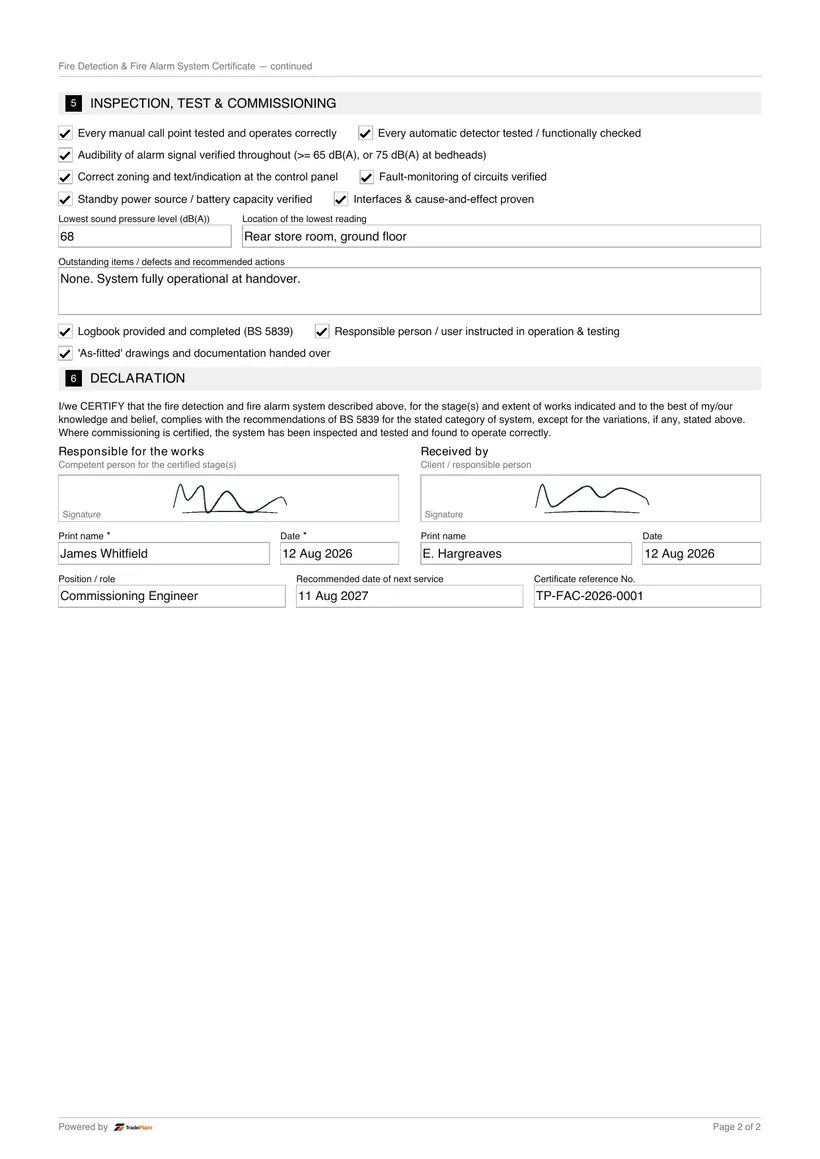
Log the results of your checks and note any variations or areas not covered so the certificate reflects exactly what was done.
Add your declaration and signature, then generate a branded PDF for the responsible person and keep a copy on file.
TradePlanr generates this and 79 other gas, electrical, oil, plumbing and renewables certificates as proper PDFs — filled on site, signed on screen and stored against the job. Works even with no signal. Free to start.
A competent person responsible for the relevant stage of work issues the certificate, for example the designer, installer or commissioning engineer, confirming their part meets BS 5839.
BS 5839-1 applies to fire detection and alarm systems in non-domestic premises such as commercial buildings, while BS 5839-6 covers systems in domestic premises.
The category defines the level of protection provided. L categories such as L1 to L5 relate to life protection with differing coverage, and M relates to manual systems. The certificate records which category applies.
The standard is associated with design, installation, commissioning and acceptance certificates, each confirming a different stage of the system has been completed to BS 5839.
Yes — design, installation, commissioning and acceptance are certified separately, because different parties may be responsible for each stage. If you carry out more than one stage you complete a certificate for each, and together they form the system's compliance record.
Domestic systems under BS 5839-6 are described by a grade (the type of equipment, from mains-powered interlinked systems down to battery alarms) and an LD category (LD1, LD2 or LD3, defining how much of the dwelling is covered). The certificate records both so the level of protection is clear.
Installation and commissioning certificate for smoke and heat alarm systems in dwellings to BS 5839-6, covering Grades and Categories LD1–LD3.
Installation, commissioning and periodic test records for emergency lighting to BS 5266.
The service and maintenance certificate for portable fire extinguishers to BS 5306-3.
TradePlanr Agency builds custom-coded, SEO-optimised websites and runs Google Ads for UK trades — from £375, by the team behind TradePlanr.
Explore TradePlanr Agency