

BS 8558 / BS EN 806

Chlorination / Disinfection Certificate (BS 8558)

Fill it in on site, sign on screen, and send a professional Chlorination PDF before you leave the job.

Free to build · Send it with a 7-day free trial

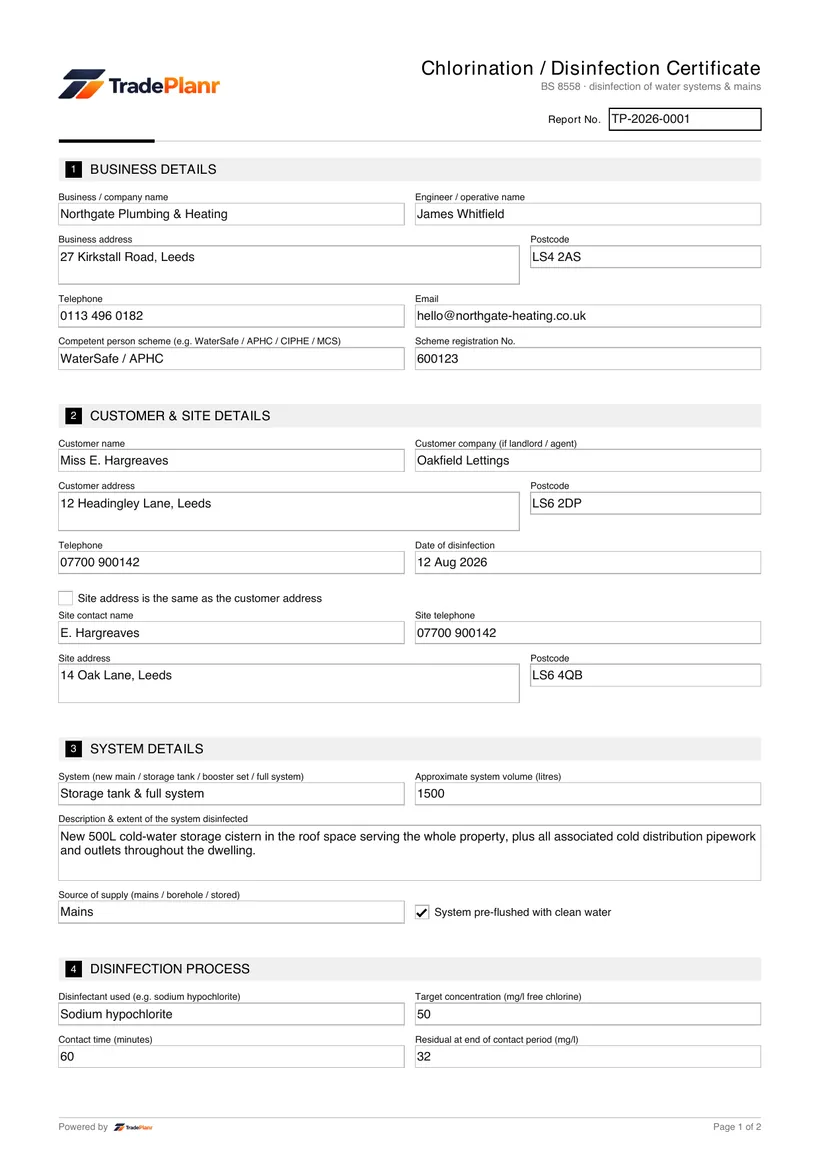
A chlorination or disinfection certificate records that a water system has been cleaned, disinfected and flushed before being put into service. It documents the disinfectant used, the concentration achieved, the contact time held and the residual measured, so there is clear evidence the system was returned to service in a wholesome condition.

Disinfection is carried out in line with BS 8558 and BS EN 806 whenever a new main or connection is brought into use, when storage tanks or systems have been worked on or may have been contaminated, and as part of Legionella control regimes. Water undertakers and clients expect a completed certificate before the system supplies drinking water.

TradePlanr lets you complete the certificate on your phone at the site, working through the system details, disinfection process, sampling and return to service in order. Capture your signature, generate a professional PDF and send it to the client or main contractor before you leave, with a copy stored against the job.

What it covers

  • Site and client details plus the system disinfected: new main, storage tank, booster set or full installation
  • System volume and confirmation of the pre-flush before disinfection
  • The disinfectant used, such as sodium hypochlorite, and the dosing method
  • Target concentration in mg/l free chlorine, contact time and the residual measured at the end of the contact period
  • Confirmation that every outlet was drawn through to distribute the disinfectant
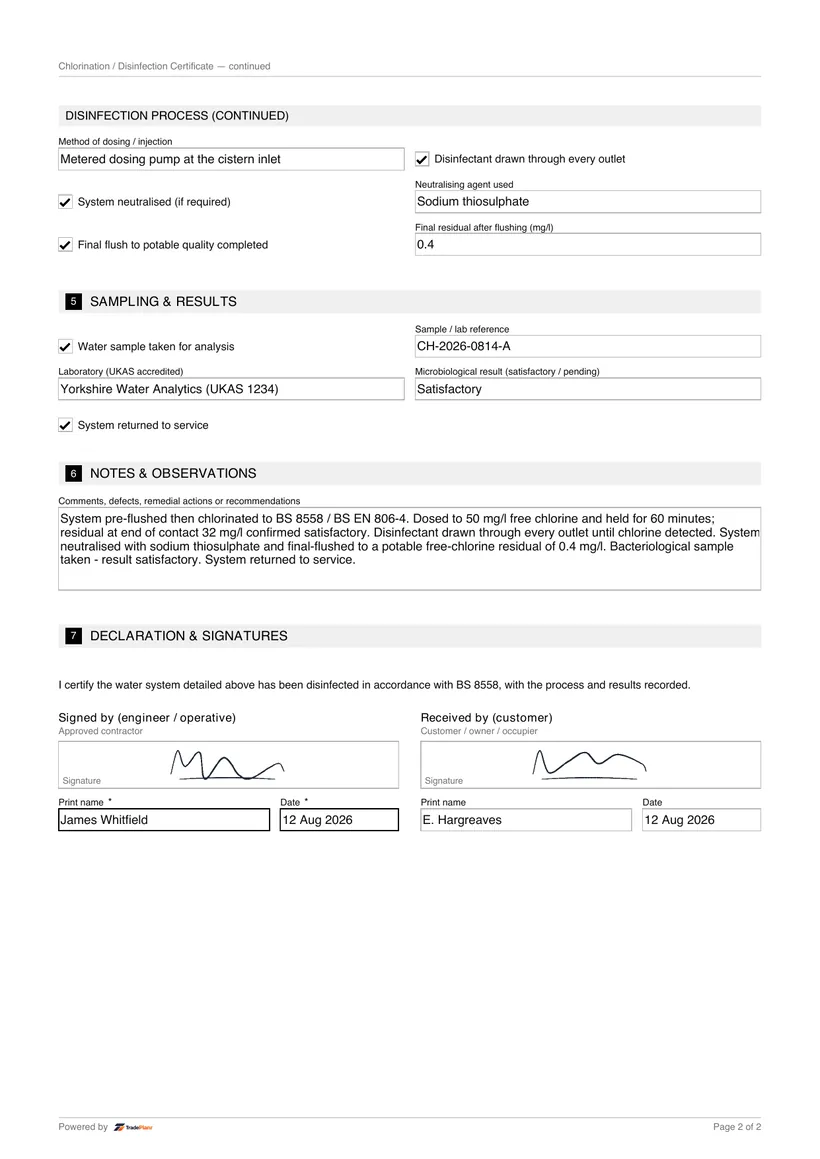
  • Neutralisation of the disinfectant and the neutralising agent used
  • The final flush and the residual measured before return to service
  • Sampling details: whether a sample was taken, the UKAS laboratory, reference and result

When it's required

New mains and new connections must be disinfected before first use. Water undertakers expect the work to be evidenced before the supply is put into service, and the certificate provides that evidence.

Storage tanks and systems are disinfected after installation, repair or alteration, or where contamination is suspected, so the system can be safely returned to service.

Commercial and healthcare projects normally require a disinfection certificate in the handover pack before a new or altered system supplies drinking water.

Sites operating a Legionella control regime use periodic disinfection and certification as part of their written scheme of control.

How to issue it in TradePlanr

  1. 1

    Enter the site and system details

    Record the property, the client and the system being disinfected, including whether it is a new main, storage tank or booster set, the system volume and the pre-flush.

  2. 2

    Record the disinfection process

    Log the disinfectant and dosing method, the target mg/l free chlorine, the contact time and the residual at the end of the contact period, confirming every outlet was drawn through.

  3. 3

    Record neutralisation and the final flush

    Note the neutralising agent used, the final flush and the residual measured before the system is returned to service.

  4. 4

    Add the sample details

    Record whether a water sample was taken, the UKAS laboratory it was sent to, the sample reference and the result when it comes back.

  5. 5

    Sign and send the PDF

    Capture the signature, generate the PDF disinfection certificate and send it to the client, main contractor or water undertaker, with a copy stored against the job.

Issue this certificate from your phone or the web

TradePlanr generates this and 45+ other gas, electrical, oil, plumbing and renewables certificates as proper PDFs — filled on site, signed on screen and stored against the job. Works even with no signal. Free to start.

Frequently asked questions

What is a chlorination certificate?

It is the record that a water system has been disinfected, neutralised and flushed before being put into service, documenting the disinfectant, concentration, contact time and residuals in line with BS 8558 and BS EN 806.

When does a water system need disinfecting?

Before a new main or connection is first used, after work on tanks or systems, where contamination is suspected, and periodically as part of a Legionella control regime.

What chlorine level is used for disinfection?

The certificate records the target free chlorine concentration in mg/l and the contact time, following the method in BS 8558, along with the residual measured at the end of the contact period to prove the level was maintained.

Do I need a water sample after disinfection?

Sampling is standard practice on mains and commercial work, with the sample analysed by a UKAS accredited laboratory. The certificate records the sample reference and the result so the system can be released into service.

Can I complete the certificate on site?

Yes. TradePlanr lets you record the disinfection process, residuals and sample details on your phone, capture the signature and produce the PDF at the property.

Start Now — It's Free

Free to start · No card · No download needed — works in your browser

Download on the App StoreGet it on Google Play