

How often should a septic tank be emptied?
Most septic tanks and treatment plants are de-sludged at least annually, though the right interval depends on the tank size and usage. The service record logs each visit and sets the next service due date.
Fill it in on site, sign on screen, and send a professional Septic PDF before you leave the job.
Free to build · Send it with a 7-day free trial
Need a Septic for your own property? It's issued by the tradesperson who does the work — TradePlanr is the app they use.
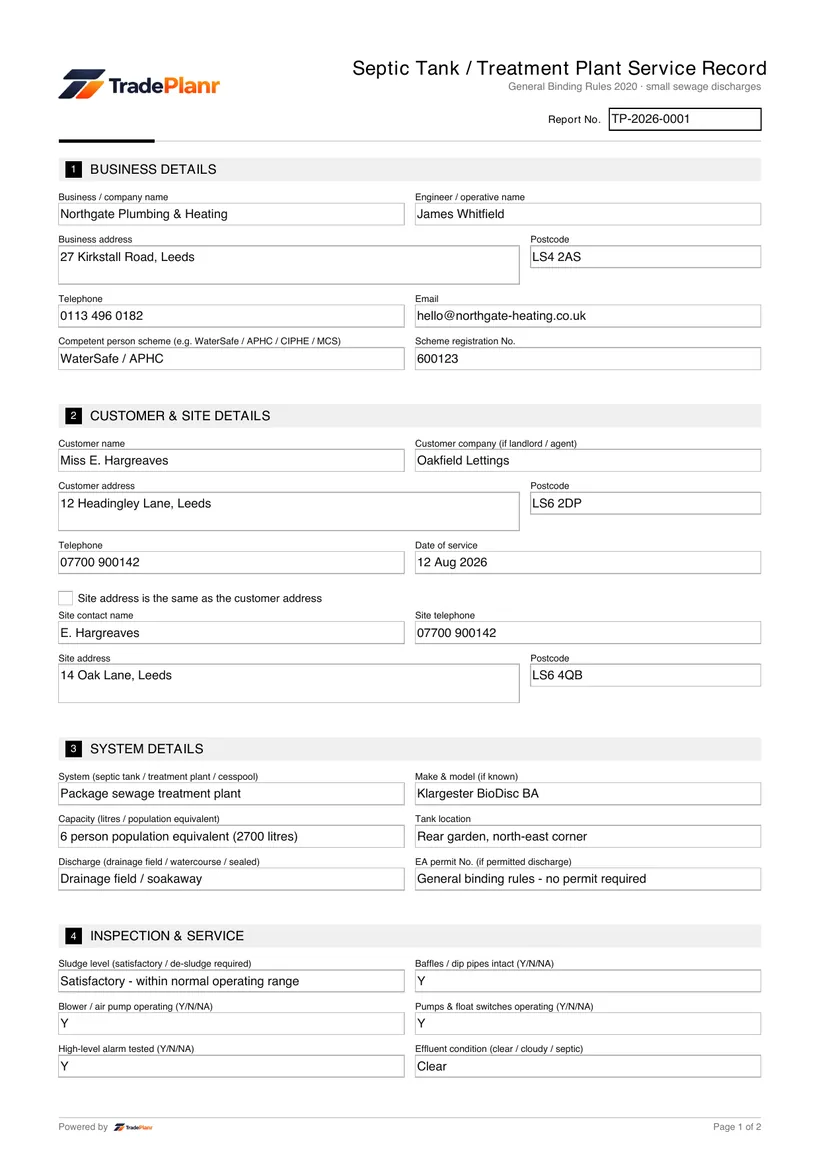
A septic tank service record documents the inspection, servicing and emptying of a septic tank, package treatment plant or cesspool. It records the condition of the tank and its components, the effluent quality observed, any de-sludge carried out and the waste transfer details, giving the owner clear evidence the system is being properly maintained.
Under the General Binding Rules 2020 for small sewage discharges, operators must keep their system properly maintained, which in practice means regular servicing and de-sludging, typically annually. Sludge must be removed by a registered waste carrier with the paperwork to prove it, and buyers and conveyancers increasingly ask for maintenance records when a property is sold.
TradePlanr lets you complete the service record on your phone at the property, working through the system details, inspection checks, de-sludge and waste transfer information in order. Sign on screen, generate a professional PDF and send it to the homeowner or site operator before you leave, with a copy stored against the job.
The General Binding Rules 2020 require small sewage discharge systems to be properly maintained, with regular servicing and de-sludging — typically at least annually for most tanks and plants.
Sludge removed from the system must be taken away by a registered waste carrier, and the transfer documentation kept as evidence. The service record captures the carrier and transfer note reference.
Package treatment plants are normally serviced to the manufacturer's schedule, and doing so keeps the discharge compliant and the plant working as designed.
When a property with a septic tank or treatment plant is sold, buyers and conveyancers expect maintenance records showing the system has been looked after.
Record the property, the system type — septic tank, package treatment plant or cesspool — its make and capacity, the discharge route and any EA permit number.
Log the sludge level, the condition of baffles and dip pipes, checks on the blower, pumps, floats and high-level alarm, the effluent condition and any ponding over the drainage field.
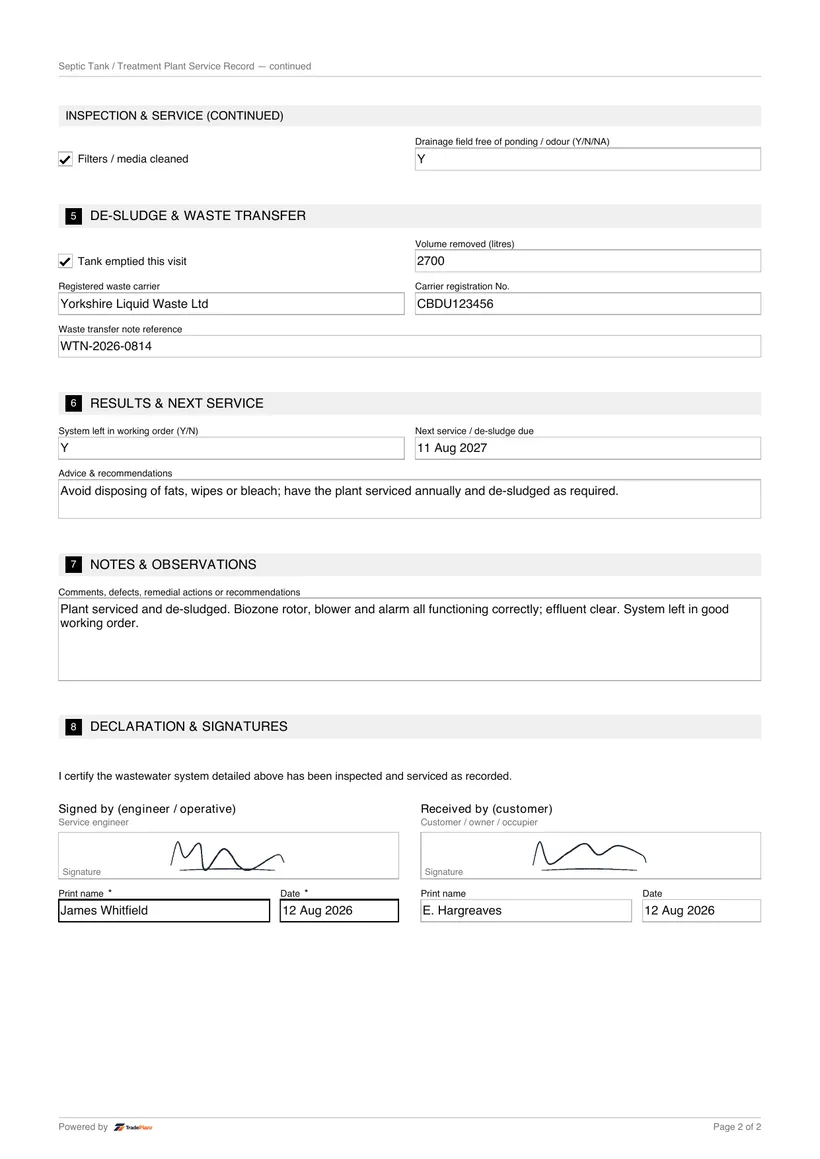
If the tank was emptied, note the volume removed, the registered waste carrier and the transfer note reference so the disposal is fully documented.
Enter the outcome, any defects or recommendations, and set the next service due date so the annual visit is not missed.
Capture the signature, generate the PDF service record and send it to the homeowner or site operator, with a copy stored against the job for their maintenance history.
This work comes due again every 12 months. When it does, TradePlanr texts your customer from your business name with a link to book you in — so the repeat job comes back to you, not whoever they find on Google.
TradePlanr generates this and 79 other gas, electrical, oil, plumbing and renewables certificates as proper PDFs — filled on site, signed on screen and stored against the job. Works even with no signal. Free to start.
Most septic tanks and treatment plants are de-sludged at least annually, though the right interval depends on the tank size and usage. The service record logs each visit and sets the next service due date.
They are the rules for small sewage discharges in England, in force since 2020. Operators must keep their system properly maintained, which means regular servicing and de-sludging with records to prove it.
Sludge must be removed by a registered waste carrier, and the transfer should be documented. The service record captures the carrier's details and the transfer note reference as evidence of proper disposal.
Buyers and conveyancers commonly ask for evidence that a septic tank or treatment plant has been maintained. A file of service records shows the system complies with the General Binding Rules.
Yes. TradePlanr lets you record the inspection, de-sludge and waste transfer details on your phone, capture the signature and send the PDF before you leave.
TradePlanr Agency builds custom-coded, SEO-optimised websites and runs Google Ads for UK trades — from £375, by the team behind TradePlanr.
Explore TradePlanr Agency