

GB F-Gas Reg 517/2014

F-Gas Refrigerant Handling Record (GB F-Gas Reg 517/2014)

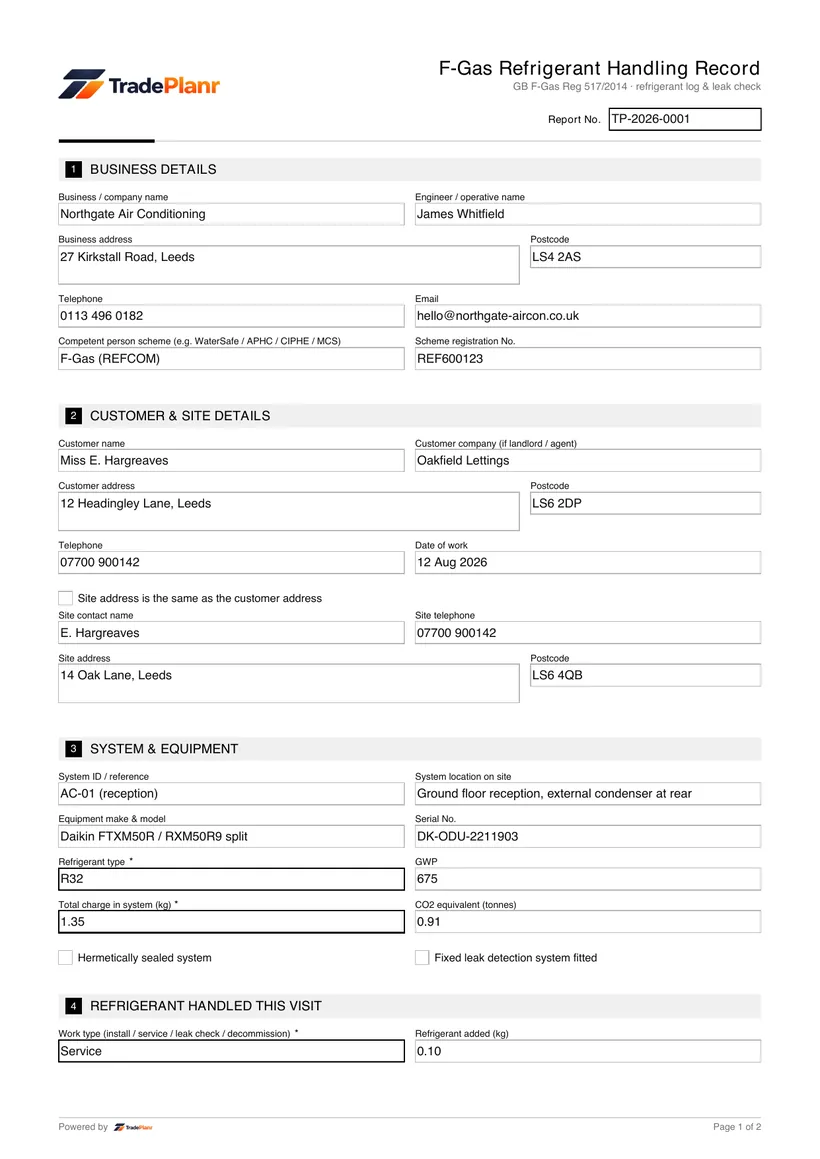
The F-Gas refrigerant handling record is the log required for equipment containing fluorinated greenhouse gases under the GB F-Gas Regulation (assimilated Regulation 517/2014). It documents the refrigerant in each system, any that is added or recovered, and the leak checks carried out over the life of the equipment.

Free plan · No card required · Works offline on site

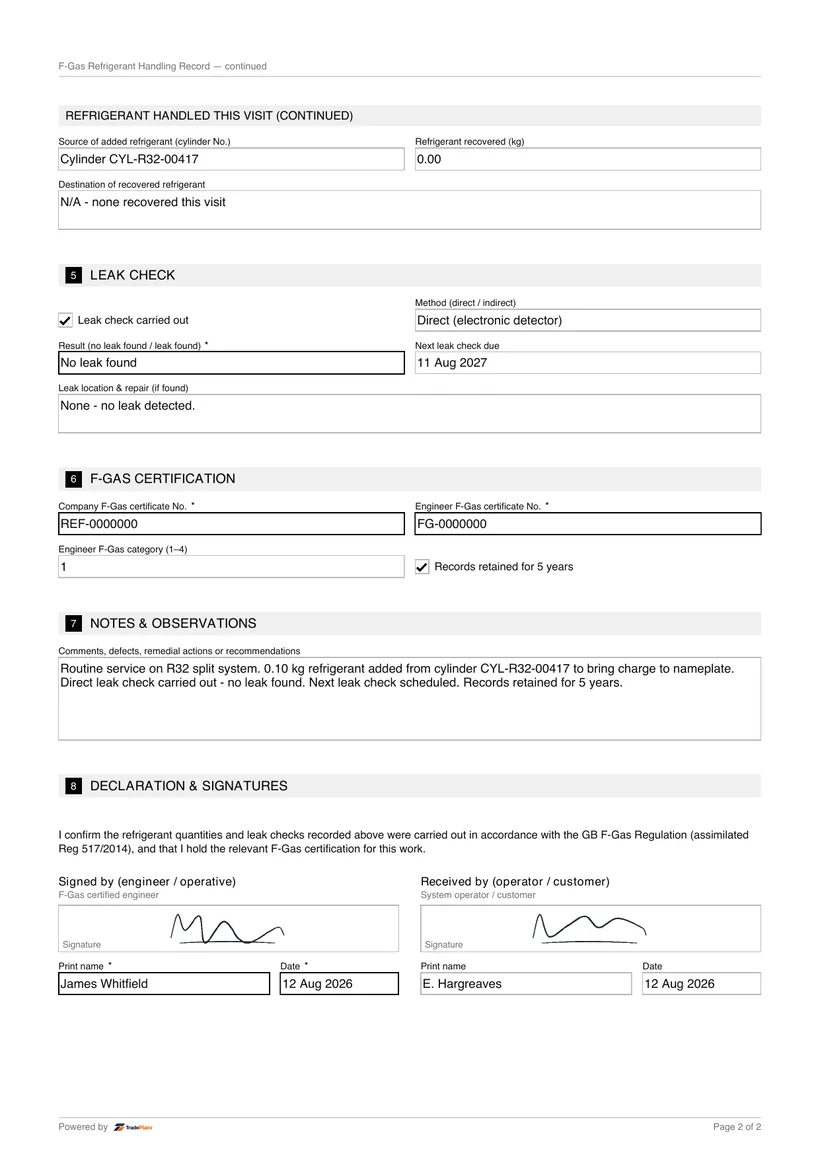
The record identifies the system and its refrigerant, sets out the total charge and the equivalent CO₂e tonnage that determines how the equipment is regulated, and captures every quantity added and recovered along with its source or destination. Leak-check dates and results, and details of any fixed leak detection, are logged as the work is done.

TradePlanr lets a certified engineer keep the refrigerant handling record on a phone or tablet, add each entry as the work happens, and produce a PDF for the operator's file that is ready to show the regulator on request.

What it covers

  • The system identification and location, and the refrigerant type
  • The total charge and the equivalent CO₂e tonnage of the system
  • Any quantity of refrigerant added, and the source of that refrigerant
  • Any quantity recovered, and its destination for reuse, recycling or destruction
  • Leak-check dates and results for each mandatory check
  • Details of any fixed leak detection system fitted and its checks
  • The certified engineer's name, F-Gas certificate number and signature
  • The date of each entry so the history of the equipment is complete

When it's required

A refrigerant handling record must be kept for equipment containing fluorinated greenhouse gases at or above 5 tonnes CO₂e. Hermetically sealed equipment is exempt below 10 tonnes CO₂e where it is labelled as hermetically sealed.

Records must be kept for at least five years and made available to the regulator on request, so they should be retained by the operator for the life of the equipment and beyond.

Only F-Gas certified engineers may carry out and record the refrigerant work, including leak checks, charging and recovery. The record captures the engineer's certificate number as evidence the work was done by a competent person.

How to issue it in TradePlanr

  1. 1

    Set up the system and its charge

    Record the system identification, refrigerant type, total charge and the equivalent CO₂e tonnage so the record shows how the equipment is regulated.

  2. 2

    Log refrigerant added and recovered

    Add each entry as the work happens, capturing any quantity added and its source, and any quantity recovered and its destination for reuse, recycling or destruction.

  3. 3

    Record leak checks and detection

    Log each leak-check date and result, and any fixed leak detection system fitted, so the mandatory checks are evidenced over the life of the equipment.

  4. 4

    Sign and store for the operator

    Add the certified engineer's name, F-Gas certificate number and signature, then generate a PDF for the operator's file, ready to show the regulator on request.

Issue this certificate from your phone or the web

TradePlanr generates this and 35+ other gas, electrical, oil, plumbing and renewables certificates as proper PDFs — filled on site, signed on screen and stored against the job. Works even with no signal. Free to start.

Frequently asked questions

Which equipment needs an F-Gas record?

A record must be kept for equipment containing fluorinated greenhouse gases at or above 5 tonnes CO₂e. Hermetically sealed equipment is exempt below 10 tonnes CO₂e where it is labelled as hermetically sealed. The record covers the charge, top-ups, recovery and leak checks.

How long must F-Gas records be kept?

Records must be kept for at least five years and made available to the regulator on request. In practice they should be retained by the operator for the working life of the equipment so its full history is available.

Who can carry out and record F-Gas work?

Only F-Gas certified engineers may carry out and record the refrigerant work, including leak checks, charging and recovery. The record captures the engineer's F-Gas certificate number as evidence the work was done by a competent person.

What is CO₂e tonnage and why does it matter?

The CO₂e tonnage is the total charge multiplied by the refrigerant's global warming potential. It determines the thresholds for record-keeping and leak-check frequency, so it is recorded for each system alongside the refrigerant type and charge.

Can I keep the F-Gas record in the app?

Yes. TradePlanr lets a certified engineer log the charge, top-ups, recovery and leak checks as the work happens and generate a PDF for the operator's file, ready to produce for the regulator.

Start Now — It's Free

Free to start · No card · No download needed — works in your browser

Download on the App StoreGet it on Google Play